
Quantum Weirdness, Bell’s Theorem, and the Question of Randomness
Introduction
Modern physics has repeatedly shown that the universe does not behave in ways that align with everyday intuition. Quantum mechanics, in particular, challenges classical assumptions about reality, causality, and determinism. A key argument for this fundamental strangeness comes from Bell’s theorem, experimentally confirmed with increasing rigor, including landmark results in 2015. These results suggest that the universe is not merely apparently weird due to human misunderstanding, but intrinsically weird at its core.

Bell’s Theorem: Reality or Locality Must Fail
Bell’s theorem demonstrates that no physical theory based on local realism can reproduce all predictions of quantum mechanics. In simple terms, the universe must give up at least one of the following assumptions:
- Realism: Particles possess definite properties (such as position or spin) prior to measurement.
- Locality: Information cannot travel faster than the speed of light.
Experiments testing Bell inequalities consistently violate the limits imposed by local realistic theories. As a result, the universe appears to be either:
- Non-real: Particles do not have definite properties until measured, existing instead as probability distributions.
- Non-local: Entangled particles influence one another instantaneously across arbitrary distances.
This conclusion does not stem from flaws in experimentation or theoretical limitations, but from the intrinsic behavior of reality at its most fundamental level.
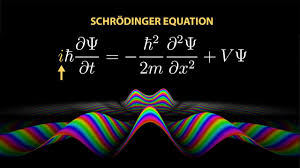
Schrödinger’s Equation and Probability Distributions
Non-realism is evident in Schrödinger’s equation, which describes quantum systems in terms of a wavefunction rather than precise trajectories. For example, an electron in a hydrogen atom does not orbit the nucleus in a classical sense; it exists as a probability cloud. Physics can predict where the electron is likely to be found, but not its exact location at a given moment. This uncertainty is not due to imperfect instruments, but is intrinsic to quantum theory.
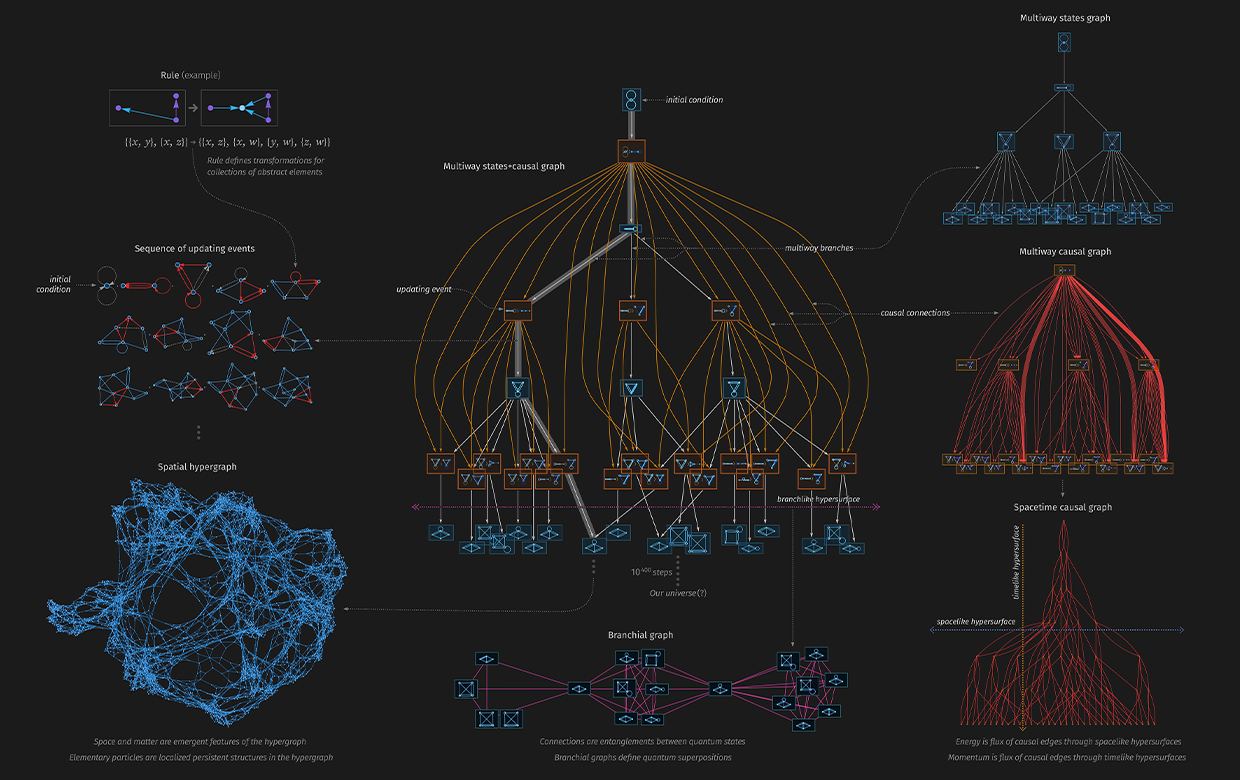
An Informational and Computational Universe
An increasingly discussed possibility is that the universe is fundamentally computational. Approaches such as Wolfram Physics suggest that reality arises from simple computational rules applied to abstract structures, with physical laws operating as algorithms and the universe progressing through discrete computational steps.
This perspective leads to a central problem: if particles are defined by probability distributions, how is a single, definite outcome—such as an electron appearing at one location—realized?
The Role of Randomness
This issue can be made concrete using a simple probabilistic example. A probability distribution by itself does not produce a specific outcome; it only defines the range and likelihood of possible outcomes. To generate a single, definite value, an additional element—random selection—is required.
import random
import numpy as np

mean = 0
std_dev = 1

# Generate a single position from a probability distribution
position = random.gauss(mean, std_dev)
print(position)
In this example, the Gaussian distribution constrains which values are possible and how likely they are, but randomness determines which particular value actually occurs.
If the universe operates in an analogous way, this suggests that:
- Physical laws define probability spaces.
- Actual events require a source of randomness to select specific outcomes.
Is There a “Pool of Randomness”?
This leads to a central philosophical and physical question: Does the universe draw from a fundamental source of randomness to manifest concrete reality?
If randomness is irreducible, then even a complete description of physical law would be insufficient to fully determine the future. Instead, reality would arise from a combination of deterministic structure and genuine unpredictability.
Such a conclusion carries significant implications:
Determinism may be false at the most fundamental level of reality.
Information, rather than matter, may be the universe’s most basic constituent.
Randomness may be as fundamental as physical law itself.
Conclusion
Bell’s theorem, quantum probability distributions, and computational approaches to physics all converge on a striking conclusion: the universe does not conform to classical intuition. Whether this departure reflects non-locality, non-realism, or an underlying source of randomness remains unresolved.
What is increasingly clear, however, is that reality is not fully deterministic, not fully local, and possibly not fully real in the classical sense. Understanding how probability gives rise to actuality may be one of the most important open questions in modern physics.